Last updated October 15, 2026
Free written scope consultation - allowances, timeline, and change-order rules on paper before a single trade is scheduled
Construction Cost Breakdown: The Torrance Homeowner’s Reference for 2026
Here’s a number that should make every Torrance homeowner pause: a kitchen remodel quoted at the “LA average” of $55,000 can realistically run $68,000 to $75,000 in Torrance once South Bay labor rates, Torrance permit fees, and the true cost of accessing older homes with limited staging space are factored in. Nobody mentions that until the change orders start arriving. This guide gives you the real line-item numbers for 2026, explains how Construction Permits, Codes & Inspections in CA: What You Need to Know actually work in Torrance, and shows you how to read a construction bid so you know exactly what you’re paying for before you sign. We’ve been building in this city since 2004, and we’ve seen every complication Torrance housing stock can throw at a remodel.
Styles & brands we work with
Quick Answer
A full kitchen remodel in Torrance in 2026 typically costs $65,000 to $95,000 for a mid-range project, while a bathroom remodel runs $28,000 to $45,000, an ADU addition lands between $180,000 and $320,000, and a whole-home remodel starts around $150,000 and can exceed $400,000 depending on square footage and structural scope. Torrance permit fees add roughly 1.5% to 4% of project cost depending on valuation, and older homes commonly carry $8,000 to $25,000 in hidden costs from asbestos abatement, galvanized pipe replacement, and electrical panel upgrades. Labor in the South Bay runs 15% to 30% above inland LA County benchmarks, which is why generic cost guides understate what you’ll actually pay here.
Table of Contents
- Line-Item Cost Breakdown for Torrance’s Most Common Projects
- How Torrance Permit Fees Are Calculated and What They Add to Your Budget
- Hidden Costs Unique to Older Torrance Housing Stock
- How to Read a Bid: Fixed Price vs. Time-and-Materials
- What Allowances in a Construction Bid Actually Mean
- The Real Cost Drivers in the South Bay: Labor, Materials, and Access
- Common Mistakes to Avoid
- When to Call a Professional
- Frequently Asked Questions
- The Bottom Line
Line-Item Cost Breakdown for Torrance’s Most Common Projects
The numbers below reflect what we’re actually quoting in Torrance for 2026. They’re not national averages. They’re based on South Bay labor rates, current material pricing from the suppliers we work with, and the realities of remodeling homes in a city where much of the housing stock dates from the 1950s and 1960s. If you’re planning to refinance or pull a HELOC to fund a remodel, these are the numbers your lender will want to see.
Kitchen Remodel (Typical 150 – 200 sq ft Torrance Kitchen)
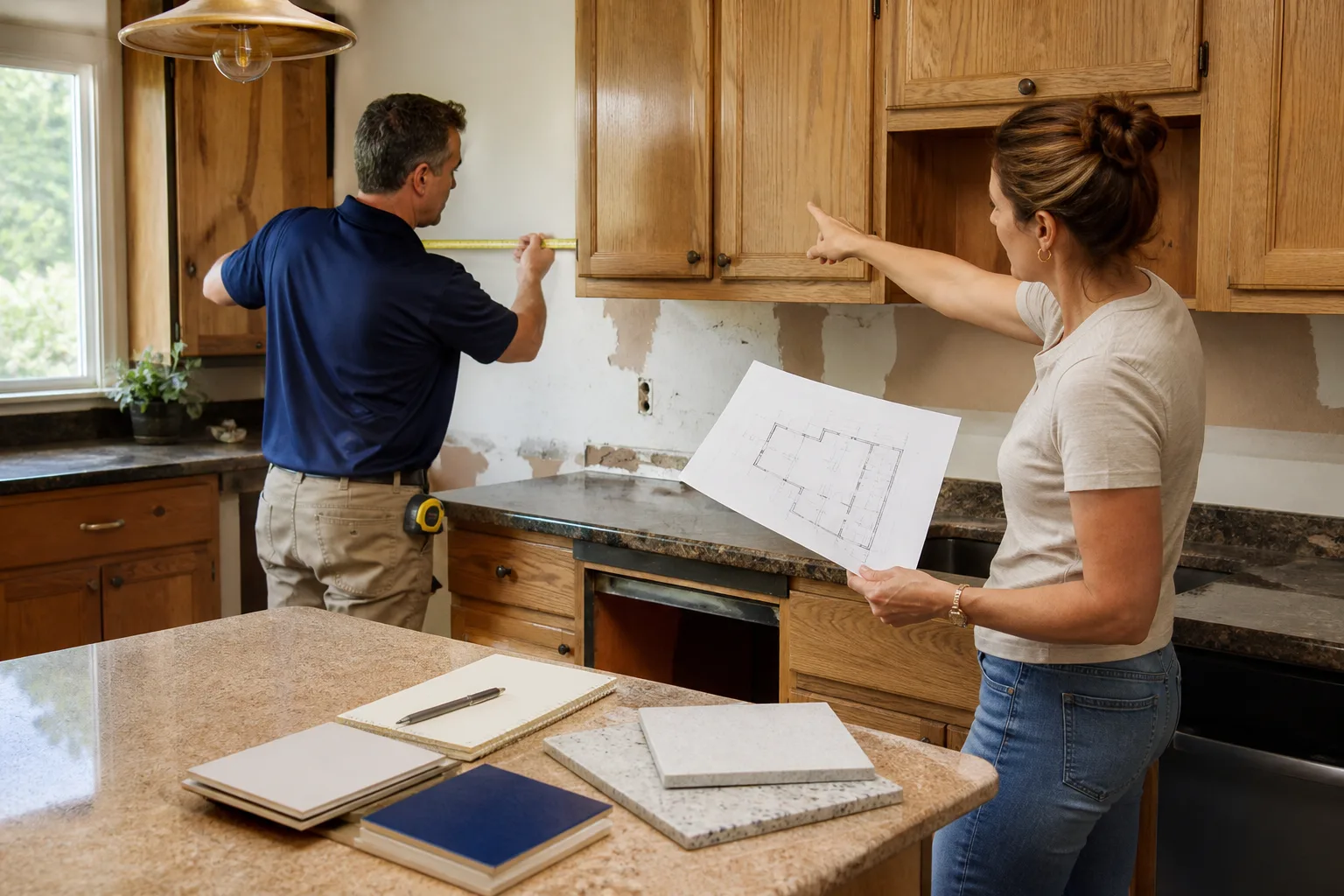
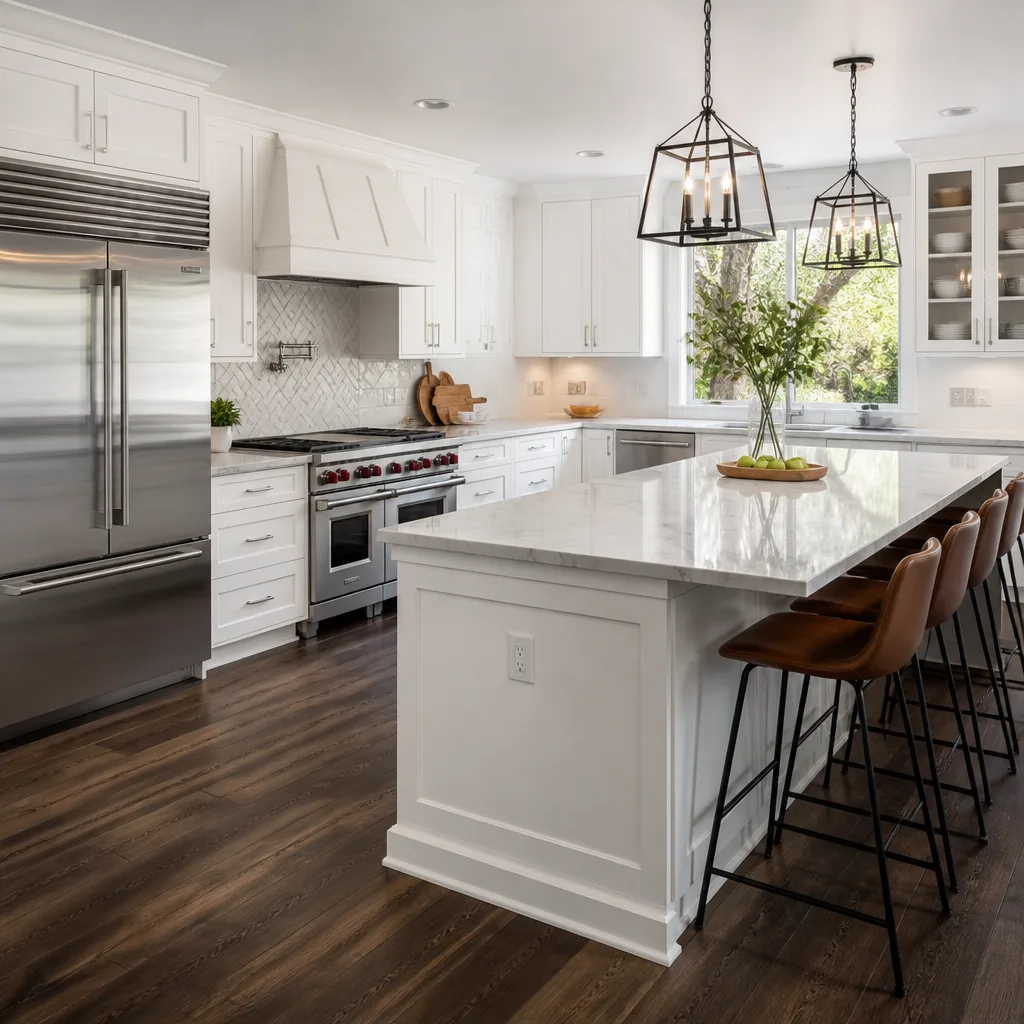
We tell homeowners to plan for $68,000 to $85,000 on a mid-range kitchen remodel in Torrance. At the low end, if you keep the existing footprint, preserve the current layout, and choose mid-tier cabinetry, expect to spend $48,000 to $60,000. At the high end, with layout changes, structural work, and specification-grade finishes, the number climbs to $95,000 to $140,000. Cabinetry is the single largest line item, and in the South Bay, homeowners consistently underestimate what cabinetry actually costs. A 10×10 kitchen with KraftMaid or Wellborn cabinets in a mid-tier door style runs $14,000 to $22,000 installed, before countertops enter the conversation.
Here’s a representative line-item breakdown for a mid-range Torrance kitchen remodel in 2026:
- Demolition and disposal: $2,800 – $4,500
- Cabinetry (mid-tier, 10 – 14 linear feet of uppers and lowers): $16,000 – $24,000
- Countertops (quartz, 40 – 55 sq ft): $6,500 – $10,000
- Plumbing rough-in and fixture installation: $3,000 – $5,500
- Electrical rough-in, new circuits, fixture installation: $4,500 – $8,000
- Flooring (tile or LVP, 150 – 200 sq ft): $3,500 – $6,000
- Drywall, paint, tile backsplash: $6,000 – $9,500
- Permits: $1,800 – $3,200
- General contractor overhead and project management: 15 – 22% of subtotal
That last line matters. General contractor overhead is where a lot of homeowners get sticker shock, but in Torrance, it covers something real: site supervision, scheduling, coordination with the city, and responsibility for every subcontractor who walks through your door. Skip that line item and you’re managing the project yourself.
Bathroom Remodel (Standard 5×8 or 5×10 Torrance Bathroom)
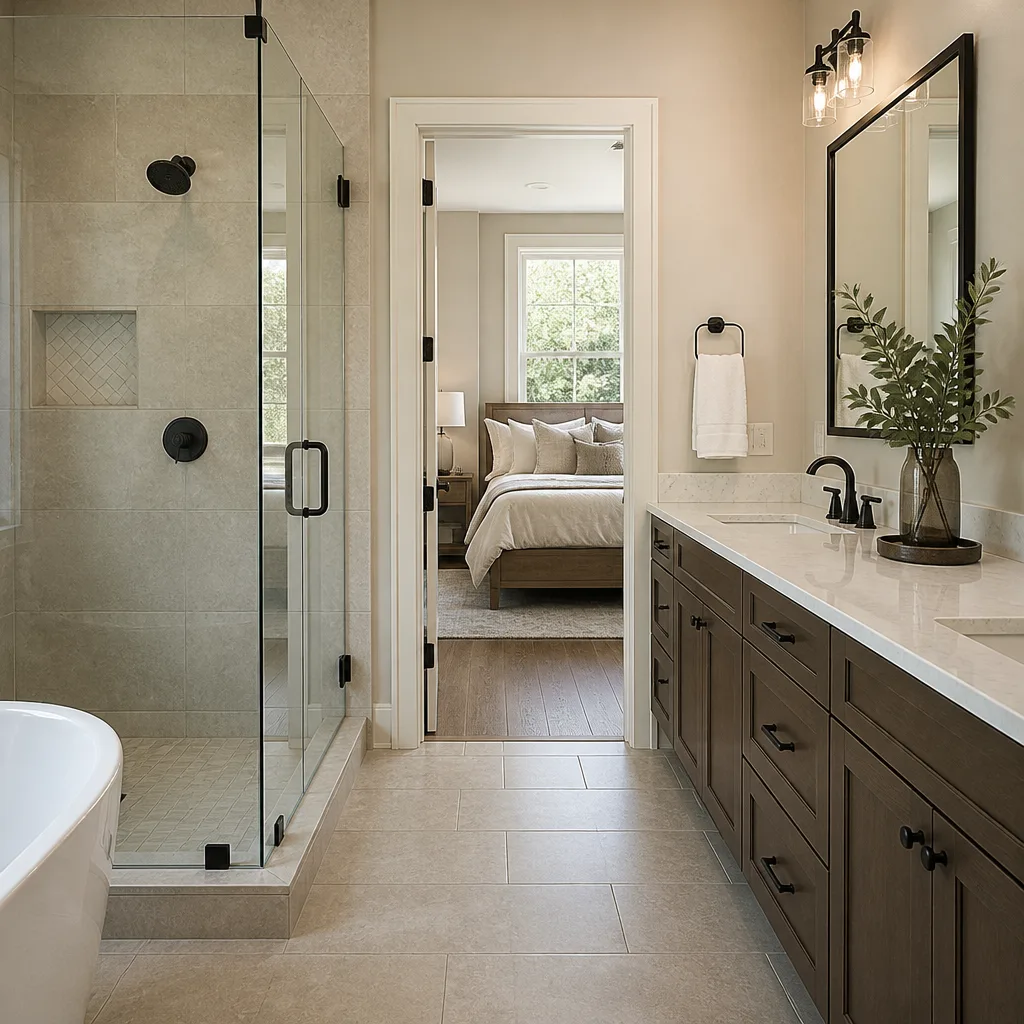
A full-gut bathroom remodel in Torrance runs $28,000 to $45,000 for a standard 5×8 or 5×10 bathroom. That assumes the bathroom gets stripped to studs, the shower or tub is replaced, the waterproofing is redone, and new tile, vanity, fixtures, and lighting go in. A cosmetic refresh (new paint, new faucet, new toilet, new light fixture) lands between $5,000 and $12,000, but that’s not really a remodel; it’s a facelift.
Torrance bathrooms built in the 1950s and 1960s frequently have cast-iron tubs that weigh 300 to 400 pounds. Removing one from a second-floor bathroom in a Torrance home with a narrow staircase adds real labor. We’ve seen demotion and disposal costs run $600 to $1,400 in these older South Bay homes, where access routes through the house are constrained. If the bathroom is on a slab foundation and the plumbing needs to be moved, add $4,000 to $9,000 for concrete cutting and pipe relocation.
A typical line-item breakdown for a mid-range bathroom remodel in Torrance:
- Demolition and disposal: $1,800 – $3,500
- Shower or tub replacement with plumbing rough-in: $6,500 – $11,000
- Tile work (shower walls and floor, 80 – 120 sq ft): $5,500 – $9,000
- Vanity, countertop, and sink: $2,500 – $5,500
- Toilet and fixture installation: $800 – $1,600
- Electrical work, including GFCI protection and vent fan: $1,800 – $3,200
- Permits: $900 – $1,800
- General contractor overhead and project management: 15 – 22% of subtotal
ADU Construction (400 – 800 sq ft Accessory Dwelling Unit)
ADUs have become one of the most common projects we bid in Torrance, especially in neighborhoods like Old Torrance and the areas east of Crenshaw Boulevard where lots are deeper. A detached new-construction ADU of 400 to 800 square feet costs $180,000 to $320,000 in Torrance in 2026. A garage conversion ADU runs $90,000 to $160,000, and an attached addition ADU falls somewhere between, usually $140,000 to $220,000 depending on whether it shares a wall with the existing home and what utility work is required to connect it.
The distinction matters because the foundation, utility trenching, and site access costs are not the same. A detached ADU in a Torrance backyard with alley access costs less to build than one squeezed behind a house in a hillside neighborhood where the only access is a 36-inch side gate, forcing crews to hand-carry materials. We’ve seen excavation and material-handling costs alone swing by $10,000 to $18,000 on the same square footage for that exact reason.
Whole-Home Remodel (1,200 – 2,000 sq ft Torrance Home)
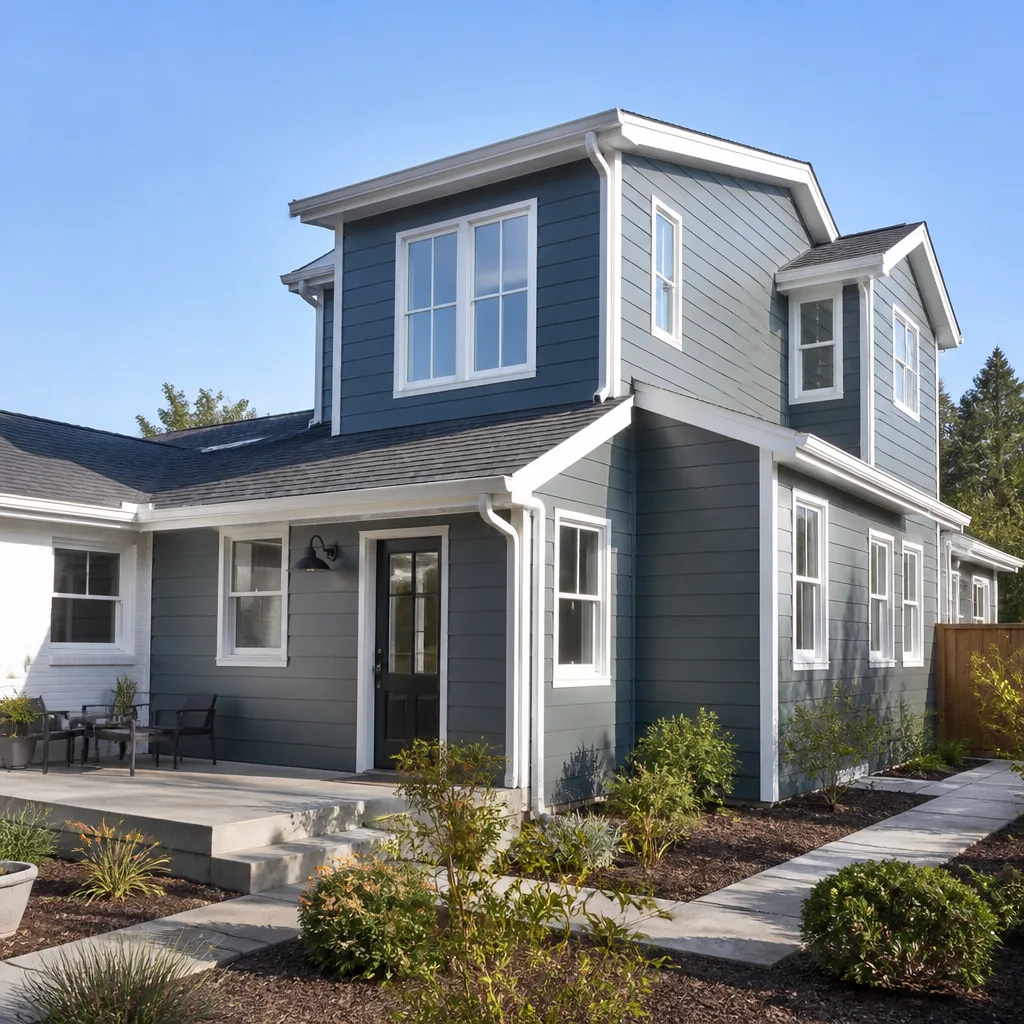
A whole-home remodel on a typical 1950s or 1960s Torrance ranch or stucco home costs $150,000 to $400,000 in 2026. The range is wide because the scope varies so much from home to home. Some homeowners want floors, kitchen, two bathrooms, paint, and lighting. Others want to move walls, re-roof, replace all the windows, and upgrade the panel to 200 amps. Every additional system touched adds cost, and in Torrance, the city’s permit triggers mean that touching one system often requires bringing others up to code.
We tell homeowners to think of a whole-home remodel this way: the kitchen consumes 30 to 35% of the budget, each bathroom consumes 15 to 20%, and the remaining 30 to 40% goes to floors, paint, doors, windows, electrical, plumbing, HVAC, and the general contractor’s management. When we remodel a home in Torrance, we always tell the homeowner about our whole-home remodeling approach in Torrance before we ever start drafting a contract, because understanding what you’re buying is the only real protection against a bad bid.
How Torrance Permit Fees Are Calculated and What They Add to Your Budget
Torrance calculates building permit fees as a percentage of the project’s declared valuation, which is the city’s way of estimating what the project costs. The fee schedule is public, and the percentages scale with the valuation. For a project valued at $50,000, expect the permit to cost roughly $1,200 to $1,800. For a project valued at $150,000, the permit might run $3,500 to $5,200. The city also charges separate fees for plan review, which typically runs 65% of the building permit fee, plus small surcharges for code enforcement and technology.
Here’s what that means in practical terms for a Torrance remodel:
- A kitchen remodel with a declared valuation of $70,000 will carry a building permit fee of approximately $1,800 to $2,400, plus plan review of roughly $1,200 to $1,600.
- A bathroom remodel with a declared valuation of $35,000 carries a building permit fee of roughly $900 to $1,300, plus plan review of $550 to $850.
- An ADU with a declared valuation of $200,000 carries a building permit fee of roughly $4,800 to $6,500, plus plan review of $3,100 to $4,200.
- If the project triggers separate electrical, plumbing, or mechanical permits, each carries its own fee based on the scope of that trade’s work.
One thing we tell every Torrance homeowner: the permit fee is never the problem. The problem is what the permit process triggers. When the city inspector comes out, they apply today’s code to whatever they see. If your panel is a Zinsco or Federal Pacific, the inspector will flag it. If the water heater doesn’t meet current strapping requirements, it gets flagged. These corrections are the “hidden” line items that appear on legitimate change orders, and they’re not the contractor padding the bill; they’re the city requiring code compliance before sign-off. We walk every one of our clients through this reality before work begins, because a homeowner who knows why a change order is coming is a homeowner who doesn’t feel blindsided.
Hidden Costs Unique to Older Torrance Housing Stock
About 70% of the homes we remodel in Torrance were built before 1980. That matters, because pre-1980 construction carries three specific cost risks that never appear in generic cost guides: asbestos in drywall compound and flooring, galvanized steel pipe in the supply lines, and electrical panels that cannot handle modern loads. Each of these carries a price tag.
Asbestos testing and abatement. If your home was built before 1980 and the remodel involves cutting into walls, ceilings, or removing old sheet flooring, the city requires asbestos testing before the permit is issued. Testing alone runs $400 to $900 for a typical multi-room project. If asbestos is found (and it is, in a meaningful percentage of older South Bay homes), abatement runs $3,000 to $12,000 depending on square footage and material type. This is not optional. A licensed abatement contractor has to do the work, and you cannot legally have a general contractor’s demo crew simply tear out the material.
Galvanized pipe replacement. Torrance homes built before the late 1960s often have galvanized steel supply pipes. When we open up a wall or slab, and the galvanized pipe is visible, the inspector will often require replacement of the accessible portion because galvanized pipe corrodes from the inside and reduces water pressure. Whole-home repiping with PEX runs $6,000 to $14,000 in Torrance. Partial replacement, only where exposed, runs $2,500 to $6,000. If the home sits on a slab and the galvanized is in the slab, the number goes higher because the old pipe has to be abandoned and new lines routed through the attic. This is real, and it comes out of the contingency budget if you haven’t planned for it.
Panel upgrades triggered by permit requirements. A 100-amp panel on a Torrance home built in 1955 will almost certainly require replacement to 200 amps once the city sees the scope of work on the permit application. Panel replacement, including new panel, new breakers, new grounding, and coordination with Southern California Edison, runs $3,500 to $7,500 in Torrance. If the service drop from the utility pole is old and needs replacement, add another $2,000 to $4,000. We tell homeowners to plan for the panel upgrade the moment the project scope includes a new kitchen or an ADU, because the circuit load calculations will drive the permit review.
None of these items are surprising to a contractor who has worked in Torrance for two decades. They are the cost of doing the work the right way, in a city where the building stock is aging. Our general contracting work in Torrance includes budgeting for these conditions up front, because writing a price that ignores them is how change orders happen later.
How to Read a Bid: Fixed Price vs. Time-and-Materials
Every construction bid in Torrance falls into one of two categories: fixed price or time-and-materials. The distinction is not a detail. It is the single most important thing you will read on the proposal. A fixed-price bid states a specific dollar amount for a defined scope of work. If the scope doesn’t change, the price doesn’t change. A time-and-materials bid charges you for the actual hours worked and the actual materials purchased, with no guaranteed final price.
Here’s how to identify which one you’re looking at:
- Look for a single total dollar figure. A fixed-price bid has a bottom line: $72,400. That number is the contract price. A time-and-materials bid quotes an hourly rate plus an estimated material cost, with language like “estimated” or “subject to final accounting.”
- Read the scope of work paragraph carefully. A fixed-price bid defines the work in specific terms: the cabinet boxes, the countertop material, the fixtures, the square footage of tile. If the scope section is vague, the bid is not really fixed price even if it has a number at the bottom.
- Check for an allowances section. Fixed-price bids almost always include allowances for selections the homeowner hasn’t made yet: flooring, tile, faucets, lighting. Time-and-materials bids may or may not include them.
- Look at the payment schedule. A fixed-price bid ties payments to milestones: deposit, rough-in, drywall, final. A time-and-materials bid often asks for periodic payments based on hours and materials in place.
The risk difference matters in real dollars. If you sign a time-and-materials contract on a kitchen remodel and the project runs two weeks over because of a permit delay or a material lead-time issue, you pay for those two weeks of labor. On a fixed-price contract, the contractor absorbs that cost. That’s why fixed-price work carries a higher base price; the contractor is pricing in the risk of overruns. It’s also why we put a written price in front of every Torrance homeowner before work begins. We want the risk allocation to be clear before anyone swings a hammer.
A third pricing model exists, and it’s the one you should be most careful with: a “cost-plus” contract, which is really just time-and-materials with a percentage markup on top. Cost-plus is appropriate for some large commercial work, but for a residential remodel in Torrance, it transfers nearly all the risk to the homeowner. If you see cost-plus language, ask why the contractor cannot give you a fixed price. If the answer is not persuasive, walk away.
What Allowances in a Construction Bid Actually Mean
An allowance is a placeholder dollar amount the contractor puts in the bid for a material or fixture you haven’t selected yet. The bid might say “flooring allowance: $6,000” or “faucet allowance: $900.” The allowance is your budget for that item. If you pick flooring that costs $5,200, you get a credit. If you pick flooring that costs $7,400, you owe the difference. Simple in concept, but in practice, allowances are where homeowners get surprised.
The most common allowance problem we see in Torrance happens with tile and plumbing fixtures. A homeowner signs a bid with a $5,000 tile allowance, goes to the showroom, falls in love with a handmade tile that runs $28 per square foot, and discovers the allowance only covers something closer to $12 per square foot. The difference on a bathroom floor and shower surround can be $4,000 to $8,000. The contractor is not cheating; the allowance was stated in the bid, and the homeowner did not register the number when they made the selection.
Here’s how to protect yourself:
- Ask the contractor to walk you through every allowance line item before you sign. A five-minute conversation about what a $5,000 tile allowance actually buys prevents a $6,000 surprise at selection time.
- Check the allowance figures against showroom pricing before you commit. Visit the showroom, price the tile, the faucets, the lighting. If the allowance numbers are far below what you actually want, adjust the bid before work starts.
- Get the allowance overage or credit process in writing. The bid should state how overages are billed and how credits are returned. If it doesn’t, ask for the language to be added.
- Lock your selections before the contractor orders materials. Once the tile is ordered, it’s yours. Changing your mind after the order is placed costs restocking fees and delay.
We’ve handled enough of these conversations to know that a homeowner who understands the allowance system before work starts is rarely surprised later. It’s why our written price always includes a detailed allowance schedule with actual dollar figures, not vague percentages.
The Real Cost Drivers in the South Bay: Labor, Materials, and Access
Why do Torrance remodels cost more than what you see in a national cost guide? Three reasons, and they compound.
First, labor. South Bay construction labor runs 15% to 30% above the national average, and it’s not because contractors are marking up arbitrarily. Workers in Torrance face the same housing costs as everyone else in Los Angeles County, and a skilled tile setter or electrician who can survive on what workers make in Kansas simply does not exist here. The labor is better, and it costs more. That is the trade.
Second, materials. Torrance sits at the far end of the 405 corridor, and delivery costs from the major material yards in Los Angeles and the Inland Empire run 8% to 15% higher than for jobs in central LA. A truckload of drywall or a delivery of cabinetry costs more to get to Torrance than to Mid-City, and that shows up in the bid. Some materials, like high-end quartz from Cambria or stone from a local Torrance fabricator, carry the same price regardless of location, but commodities like lumber, drywall, and concrete all carry South Bay delivery premiums.
Third, access. This is the one most people never think about until they watch a crew try to carry a 10-foot slab of quartz through a 50-year-old Torrance home with a narrow side gate, a tight hallway, and a 90-degree turn at the front door. Older Torrance homes were not built for modern remodels. No staging area on the street, no wide driveway, no alley access in many neighborhoods. Every one of those constraints adds labor hours to the job. If you’re wondering why your neighbor’s kitchen remodel in a 2004-era tract home in a master-planned community cost less than your kitchen remodel in a 1958 ranch in Torrance, access is part of the answer. For Construction Warning Signs: A Torrance Homeowner’s Reference Guide on other red flags, see our related post.
We know these numbers because we’ve lived them. When we do a Mason Remodeling Co Torrance home renovation quote, we walk the site and account for access before we write a number. The access constraints don’t change; they just have to be priced honestly.
Common Mistakes to Avoid
- Trusting an “LA average” cost figure for a Torrance project. The South Bay is its own labor market. National and county-wide averages understate local costs by 15% to 30%. Use Torrance-specific numbers, like the ones in this guide, for anything you’re planning to budget.
- Signing a time-and-materials contract for a project with a well-defined scope. If the work can be described in writing, it can be priced in writing. A fixed price protects you from the contractor’s schedule risk.
- Ignoring the allowance schedule. The allowance numbers in your bid are not decoration. They are the budget for your tile, fixtures, and flooring. Read them, shop against them, and adjust before you sign.
- Skipping the permit to save money. In Torrance, unpermitted work is discoverable at resale, and it can kill a sale or force you to open walls for inspection years later. The permit fee is a small cost relative to the risk of working without one.
- Planning a remodel without budgeting for the panel upgrade. If your Torrance home is pre-1980 and the project adds a kitchen or ADU, the panel upgrade is nearly certain. Budget for it from day one.
- Hiring the cheapest bid without comparing scope, not just price. A low bid that omits the asbestos testing, the galvanized repipe, or the panel upgrade is not cheaper; it’s just deferred. The costs will surface as change orders later.
- Making material selections during construction. Every selection delay adds labor days. Select before demo starts, and you’ll save thousands on a multi-week project.
When to Call a Professional
Any project that involves structural work, plumbing, electrical, or moving walls requires a licensed general contractor. In Torrance, the city’s permit process effectively demands professional drawings and a contractor of record for anything beyond cosmetic work. If the scope includes a kitchen, a bathroom, an ADU, or any project where the total value exceeds $15,000, you need someone who has pulled permits in this city before and knows what the inspectors look for. If you’re not sure whether your project needs permits or what it will really cost, explore our more guides & resources or start with a conversation. Mason Remodeling Co Torrance offers free estimates in Torrance. Call (424) 337-6939 and we’ll walk the site, talk through the numbers, and put a written price in front of you before any commitment.
Frequently Asked Questions
A mid-range kitchen remodel in Torrance costs $65,000 to $95,000 in 2026, depending on the layout changes, cabinetry selection, and the condition of the existing plumbing and electrical. The low end assumes you keep the current footprint and choose mid-tier materials; the high end includes structural changes and specification-grade finishes. Call (424) 337-6939 for a free estimate that reflects your actual kitchen, not a generic average.
Torrance building permit fees are calculated as a percentage of the project’s declared valuation, with plan review adding another 65% of the permit fee on top. A $70,000 kitchen remodel typically carries $3,000 to $4,000 in total permit and plan review costs. Call (424) 337-6939 and we’ll tell you exactly what the permit will cost for your specific scope.
Not if you signed a fixed-price contract and the scope doesn’t change. The price changes only when the city requires code corrections that weren’t visible before demo (like a panel upgrade or galvanized pipe replacement), which is why those conditions should be budgeted up front. Ask for a written price before work starts, and insist the contract states how change orders are handled.
Yes, if you’re changing plumbing, electrical, or the shower waterproofing, which is virtually every bathroom remodel. Torrance requires permits for any work that alters plumbing or electrical systems, and the city’s inspectors will check the waterproofing work at the rough-in stage. Working without a permit creates real problems at resale.
Whole-home repiping with PEX in Torrance runs $6,000 to $14,000 depending on house size and the number of fixtures. Partial replacement, limited to the areas exposed during a remodel, runs $2,500 to $6,000. If the pipes are in the slab, the cost goes higher because the old lines get abandoned and new lines are routed through the attic. Call (424) 337-6939 for a firm price on your home.
A whole-home remodel on a 1,500 to 2,000 square foot Torrance home typically takes 5 to 9 months from permit issuance to final inspection. Torrance’s plan check and inspection schedule adds time compared to cities with less volume, and material lead times on cabinetry and windows are running 6 to 14 weeks in 2026. We provide a written schedule with the written price, and we update it as the project progresses.
The Bottom Line
Torrance is not Los Angeles. The labor market is tighter, the permit fees are specific, and the housing stock is older. A homeowner who budgets from a national average is budgeting to be surprised. The real numbers for a kitchen, bath, ADU, or whole-home remodel in Torrance are all in this guide, along with the hidden costs (panel, galvanized, asbestos, access) that separate a well-run remodel from a painful one. The best protection you have is a written fixed price from a company that has been doing bathroom remodeling in Torrance and general contracting work in this city since 2004. We know the codes, the inspectors, and the houses. Call (424) 337-6939 for a free estimate, and get a written price before you commit to anything.
Written by Isaac Pruett, Owner at Mason Remodeling Co Torrance, serving Torrance since 2004.
See the difference
 Before
 After
After Before
 After
After Before
 After
After